Thursday, July 13, 2006

Vacation Bible School Redux

A couple of weeks ago, I finally got around to installing a counter on this blog. For those of you who don’t know, I can now log into my Sitemeter account and find out all sorts of neat stuff about the people who visit. One interesting thing I can find out is the search terms that people use in Google that lead people to my blog. By far, the most viewed page on my blog is my post about Vacation Bible School. Lots of people are googling the terms arctic edge theme craft snacks songs. Apparently, lots of churches are doing this Arctic Edge VBS, but they don’t have much of an idea of what songs to sing, what crafts to make, and what snacks to serve.

Here’s my suggestion: Stick with what you know. If you don’t know anything about the Arctic, then don’t try to work it into your VBS program. If you can’t figure out how to use a popular theme to connect kids with God and Jesus, then just stick with what’s in the bible. The kids will get more out of it; you’ll get more out of it, and Jesus will likely appreciate not having to dress up in a parka in the middle of July.

If you must have a theme, though, I do have good news for you. Next summer Jesus gets to play football. I'm sure the men in the church will not lack for ideas on that one.

Monday, July 10, 2006

Van Hilleary must still be mad about losing the governor's race.

I was just looking at Van Hilleary's website and noticed a common theme in his language:

fighter for the conservative cause
fight his way through the House
stood up to anyone...taking on members of his own party
took on ex-governor Don Sundquist
fight for our principles

And in his new TV ad, he's saying we should vote for him because when he was in Congress he consistently voted against Bill Clinton more than anyone else, and if he's elected to the Senate he'll fight against Hillary Clinton. Van Hilleary's language shows that he cares more about fighting to get his own way than working together with others to get something done. I'll bet he received unsatisfactory marks on his kindergarten report card in "Plays Well With Others."

Saturday, July 08, 2006

In Search of Brisket

I have been sitting here watching the Food Network's shows about barbeque contests, and it's making me want some good brisket. Husband and I went to the new Famous Dave's in Smyrna last weekend and were sorely disappointed. When we first started eating at Famous Dave's a few years ago, we were really impressed with their brisket, but here lately the meat is full of fat and doesn't have a very good flavor. If I'm going to pay ten dollars for a plate of barbeque, I want something better than what they've been serving lately.

We built a smoker on our patio a couple of years ago, but it hasn't seen much action lately. With it being so hard to find good beef already cooked, I think it's time to fire up the smoker and stay up all night.

Wednesday, July 05, 2006

God Was at the Lake

The holiday weekend was really nice. Husband was off four four days, and he's off again today too because it's raining. Today will probably be a lazy lay-around-on-the-couch day.

We spent Saturday night at the lake on Husband's brother's houseboat. That was fun, but the next morning as I was lying in the sun working on my tan, I got some bug bites that are still itching this morning.

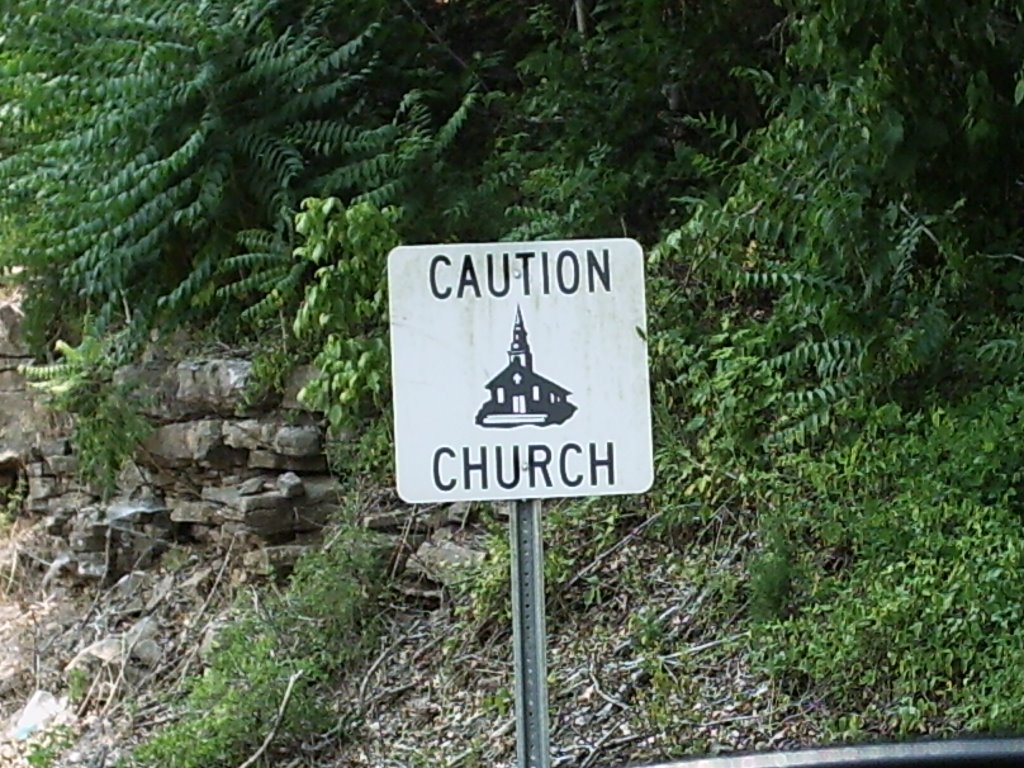
We saw this funny sign on the way to the marina:


The church was just a little white, wood-frame church; it looked relatively harmless, but we hurried past it anyway. We knew God wasn't there because another church had a sign that said God would be there on Sunday.

Last night we sat out in our yard and watched my brother shoot off some fireworks. We could also see the ones from two neighbors', and we could hear the repercussions from other displays that we couldn't see. I wonder if that's what it sounds like in a war zone?

All in all, my long weekend was pretty uneventful and relaxing, and I'm looking forward to another month and a half of uneventful relaxing summer before school starts.

Saturday, July 01, 2006

Don't Make a Federal Case Out of Homeowner Association Rules

The flag desecration amendment did not pass this week, but another flag bill did. H.R. 42, the "Freedom to Display the Flag" bill makes it illegal for condominiums and neighborhood associations to place restrictions on the size and placement of the flag as displayed by residents.

I will agree that homeowners' associations sometimes create really stupid rules. I would never live in a neighborhood that imposed regulations on what decorations I can and cannot have in my yard or whether I can have my garage door up. If I like plastic pink flamingoes, then I should be able to have them in my yard if I want.

However, many people live in such neighborhoods because those areas tend to denote a certain lifestyle. The restrictions placed on homeowners discourage certain types of people from living there. People who don't care to keep up landscaping guidelines or who can't afford to hire landscapers to keep up their flowerbeds tend not to live in these neighborhoods. People who own a bass boat or a camper trailer but who can't afford to pay the fee involved in keeping it at a storage unit so that it won't clutter up the driveway will be discouraged from living in restricted neighborhoods. And certainly someone who would put a car up on blocks in the front--or back--yard would not be allowed to live in those areas. Neighborhood associations exist for the sole purpose of "keeping up appearances," of pricing the "less desireable" people out of the market.

So, when you move into a neighborhood that imposes restrictions on its residents, you shouldn't complain even when the restriction applies to the display of the flag. You chose to live in an exclusive neighborhood. You chose to live under a certain set of rules so that you can enjoy a certain lifestyle. If you want the rules changed in your little world, then get together with your neighbors and participate in democracy and vote as a neighborhood to change the rules. Don't put it off on a federal government that has much bigger things to worry about.

Tuesday, June 27, 2006

Politics as Usual, This Time at the County Level

I just love the way the local news reporters are trying to make us feel better about a property tax hike in Rutherford County. The tax rate is going up by 9 cents, but that isn’t as bad, they say, as the original plan which would have us paying 26 cents more. Oh, I feel so much better. What the news reports have failed to mention is the fact that we received new property tax assessments last month. The appraised value of my house went up over $50,000 since the previous assessment (which couldn’t have been more than four years ago). This made the assessed value go up by over $11,000. When I do the math, I find that my effective tax increase will be nearly 60 cents. Who do they think they’re fooling?

I suppose I should be comforted by the fact that they think my house is worth so much, but I’ll bet that if the county suddenly wanted my land for something, they wouldn’t want to pay me what they say is the appraised value.

Same Song, Different Verse

Now it has been revealed that the U. S. government has been tracking the bank transactions of American citizens--but only international transactions. Only transactions in which money is transferred overseas are being watched. Why do I believe that this song can be sung to the same tune as "We're only keeping track of international phone calls"?

Monday, June 26, 2006

Starting Over

Over the weekend I heard some political news that I wanted to rant about, but I didn't want to post over my discussion of miracles. So in an effort to rant when I want and to also have an ongoing discussion of spiritual/biblical matters, I have re-formatted this blog, and I have created a new one called "Musings From the Chariot." I created the name from the story in Acts 8 of Philip riding in the chariot with the Ethiopian eunuch and explaining the scriptures to him. I figure that like the eunuch, all of us are lacking some understanding, but like Philip, all of us can offer some explanations as well. (Just what did you think I was going to say that the eunuch was lacking?)

I have copied my Miracles post and placed it on the new blog, and I took the liberty of reproducing Tony's comment (I hope you don't mind, Tony) over there as well, so go on over and take a look if you want.

Friday, June 23, 2006

I Am SO Excited!!

I can hardly believe it! This is the most exciting thing to happen to me in a long time! (That's pretty sad when you stop to think about it.)

I was quoted at Slate.com. Check out the third paragraph.

OK, now that the excitement has passed, let's go back to my previous post and have a discussion.

Receiving a Miracle

Matthew 13.53-58 relates the story of the people of Nazareth not believing in Jesus because they knew him and his family so well. Verse 58 ends the account by saying that Jesus did not do any miracles there because of the people's unbelief. However, Mark 6.1-6 tells the same story but says that Jesus could not do any powerful miracles there except for healing a few sick people.

So which is it? Did Jesus choose not to do any big miracles in Nazareth because the people didn't believe in him, or did he have an inability to do big miracles? I have a theory: Perhaps Jesus healed a few sick people because those sick people believed he could do it, but he didn't perform great public miracles--like turning water into wine or multiplying bread and fish--because the people as a whole didn't believe in him. I think that besides the power of the one performing the miracle, the belief of everyone involved is a key ingredient.

Matthew 9.27-31 relates a story of Jesus healing some blind men. Before healing them, he asks them if they believe that he can heal them, and they answer that, yes, they do. Jesus replies, "According to your faith, it will be done." The mens' faith plays a part in their receiving a miracle. Jesus reinforces this idea with his disciples in an account in Mark 11.20-26. He tells them that when they pray, they must have complete faith that God will grant their request; in fact, they must believe that what they are asking for is occuring even as they ask it. This principle is demonstrated in Matthew 8 and Luke 7 when a Roman centurian comes and asks Jesus to heal his servant. The centurian tells Jesus not to bother coming to his house because he knows that Jesus has the authority to perform a miracle from where he stands. Jesus commends the man for his faith and says that what he has requested will be done. The man's servant was healed in that very hour. Obviously, the centurion's belief in Jesus' power played a role in the healing of the servant.

The gospels record many instances of Jesus condemning the people because of their lack of belief. Our belief in God's ability to provide is key to our receiving anything from him. Does this mean that if we truly believe that God will do it, we can ask for anything and receive it? I'll discuss that next.

Wednesday, June 21, 2006

Poem for the First Day of Summer

"Summer Wind"
William Cullen Bryant

IT is a sultry day; the sun has drank
The dew that lay upon the morning grass,
There is no rustling in the lofty elm
That canopies my dwelling, and its shade
Scarce cools me. All is silent, save the faint
And interrupted murmur of the bee,
Settling on the sick flowers, and then again
Instantly on the wing. The plants around
Feel the too potent fervors; the tall maize
Rolls up its long green leaves; the clover droops
Its tender foliage, and declines its blooms.
But far in the fierce sunshine tower the hills,
With all their growth of woods, silent and stern,
As if the scorching heat and dazzling light
Were but an element they loved. Bright clouds,
Motionless pillars of the brazen heaven;--
Their bases on the mountains--their white tops
Shining in the far ether--fire the air
With a reflected radiance, and make turn
The gazer's eye away. For me, I lie
Languidly in the shade, where the thick turf,
Yet virgin from the kisses of the sun,
Retains some freshness, and I woo the wind
That still delays its coming. Why so slow,
Gentle and voluble spirit of the air?
Oh, come and breathe upon the fainting earth
Coolness and life. Is it that in his caves
He hears me? See, on yonder woody ridge,
The pine is bending his proud top, and now,
Among the nearer groves, chesnut and oak
Are tossing their green boughs about. He comes!
Lo, where the grassy meadow runs in waves!
The deep distressful silence of the scene
Breaks up with mingling of unnumbered sounds
And universal motion. He is come,
Shaking a shower of blossoms from the shrubs,
And bearing on the fragrance; and he brings
Music of birds, and rustling of young boughs,
And sound of swaying branches, and the voice
Of distant waterfalls. All the green herbs
Are stirring in his breath; a thousand flowers,
By the road-side and the borders of the brook,
Nod gaily to each other; glossy leaves
Are twinkling in the sun, as if the dew
Were on them yet, and silver waters break
Into small waves and sparkle as he comes.

Tuesday, June 13, 2006

What's the Theme This Summer?

Vacation Bible School is starting up again. I can remember going to VBS every year when I was a kid. In fact, sometimes I went to more than one during a summer. They always played out the same way. We'd start by lining up outside, and the adults would choose three kids to get to carry the bible, the American flag, and the Christian flag. Those three kids would stand up at the front of the line and lead all the rest of the kids into the church building. Then we'd sing some songs, and then we'd go to our respective classes. I don't remember much about the actual lessons. I know that we read from the bible and had to learn a "memory verse" like "All we like sheep have gone astray; we have turned everyone to his own way, Isaiah 53:6." (Funny how that came flooding back all of a sudden, and I heard it in my head being said by little kid voices.) Hwwever, I do remember making different little art projects like a bottle covered with small pieces of masking tape and then painted with shoe polish--to make it look like an antique vase with cracks in it. Another year we made a cross out of matches. That sounds like it wouldn't be much to it, but what we did was we struck a bunch of matches and then immediately blew them out and then laid them out in rows and columns to create a cross with sort of a shadow effect. It was pretty enough that parents could frame it and hang it on the wall. I remember that my grandma had one hanging in her house after that particular year. If I remember right, she may have been the one to help all us kids make those. Anyway, we'd do art and then we'd have a snack consisting of Kool-aid and those little lemon-flavored flower-shaped cookies with the hole in the middle, and then we'd go outside and have a game of Red Rover. Nowadays you'll be hard pressed to find a VBS that allows the kids to play with matches and then go play Red Rover.

A few years ago, I volunteered to help out with VBS at church. VBS has changed a lot since I grew up. For those of you who haven't payed attention, VBS has a new theme every year. The year I helped out it was "Wild Frontier Bible Theme Park"--we had to yell "Yee-haw" every now and then. Really cheesy! This year I've noticed that a couple of churches are doing one called "Arctic Edge." What kind of theme is that? Perhaps it is one that can be modified for the particular political leaning of the church or community--if you're more Democrat you can teach the kids about the fact that the Arctic glaciers are melting and that we need to be good to the earth that God gave us. If you're more Republican then you can teach the kids that global warming is a myth and that the Arctic contains oil that God gave us to use so that we can be better able to truck food to other kids that don't have any. (I'm kidding.) (Sort of.)

Yes, nowadays everything that takes place at VBS has to adhere to the theme, from the songs to the craft projects (not good crafts that took the whole week to make like when I was a kid), even down to the snack, which the children prepare for themselves from ingredients handed out by the adults. You know, some big company pays people to come up with these themes, compose new songs to fit the theme, make up a weird snack, and create a craft project for every day of the event--a craft likely made from paper and cardboard components that come in the VBS kit and that will probably end up in the trash the very next week. Some CEO is making big bucks off of these churches who think that they have to transform the church building into a scene from a big budget movie in order for kids to learn something about God. It's too bad that the message of Christianity has become so boring that we have to dress it up with a theme.

I realize that kids naturally have short attention spans, and the fact that the media constantly bombard them with ever-changing stimuli doesn't help, but it seems that church is exacerbating the problem by dressing Jesus up so that he can compete with the latest video game. The message of Jesus is unchanging; he shouldn't have to put on a different costume every summer so that kids will pay attention to him. And anyway, I have a sneaking suspicion that whatever the current VBS theme is, it's going to blend in so much with whatever movies the kids watch and whatever vacation they go on this summer that the message the kids are supposed to remember about Jesus won't even be that memorable.

----------------------------------

As I was writing this, I looked online at some various VBS themes and found this one that is particularly disturbing: Army Adventure Camp. Go take a look at it.

Wednesday, June 07, 2006

Immigration Reform is Eroding the Rights of Citizens

The immigration reform measures being debated in Congress right now are about much more than illegal immigration. One section of the immigration reform bill (H. R. 4437) provides for the verification of the status of all people applying for employment in the United States. Under the guise of controlling the inflow of immigrants and keeping track of “guest workers,” our government will set up a database which will more easily identify who is and is not eligible to work in our country. This will include U.S. citizens as well as non-citizens. Sections 701, 702, and 703 of the House version of the bill stipulate that not only will people applying for jobs be subject to verification, but eventually (within six years of the bill’s passing) all previously hired people in any job will be checked. In other words, anyone who is working at a job will have his or her social security number run through the government database in order to verify whether or not he or she is eligible to work in the United States.

You may be wondering why this measure is any different from the current paperwork you fill out when you are hired at a new job. Currently, when we get a new job, we must fill out an I-9 form and provide our new employer with a copy of our social security card. An I-9 form, you may remember, is a form you sign verifying your legal status to work in the United States--sort of like "your word is your bond." This form is kept on file in your employer’s human resource office. If a question comes up about your status, the government can review the documentation you have provided. With the establishment of a centralized database, however, employers can call a toll-free number and receive instant verification of your identity and employment eligibility status before hiring you. If for some reason the database suspects a fraudulent use of your social security number, the Department of Homeland Security will conduct an investigation. If the investigation does not indicate any fraudulent use, the employer can then feel free to hire you. (The bill contains a provision stating that the federal government cannot be held liable for mistakes that cause you not to be hired.)

(The above summary is based on my brief reading of the very intense bill, and on readings of summaries of the bill that I found online.)

If this system will help the authorities to catch illegal aliens, why am I concerned? If I have done everything right, why do I have a problem with the use of a centralized database? In this age of identity theft, it’s entirely possible that someone could get his or her hands on my social security number and use it without my knowledge. By the time the mess is cleared up and I am proven to have done nothing wrong, I could have been without a job for a while. And that’s the fundamental problem of this system: If a check of my social security number indicates some fraud, rather than being presumed innocent, I have to be proven innocent, and I cannot work until I have done so.

Here’s something else that bothers me: As we have recently learned, the federal government has been collecting our phone records for quite some time in an effort to “to form a database to detect potential terrorist activity,” according to an NPR story. According to a story in the Washington Post, “Intelligence analysts are seeking to mine [phone company] records to expose hidden connections and details of social networks, hoping to find signs of terrorist plots in the vast sea of innocent contacts.” The USA-PATRIOT Act loosened the rules that govern federal surveillance of U.S. citizens, all as part of an effort to identify potential terrorists. Our government can collect all types of information from banking records to lists of books terror suspects have checked out from the library. Judging from the fact that our president has admitted that the NSA has been spying on the phone records of all Americans and not just terror suspects, we can assume that the government is spying on other aspects of all Americans’ lives as well. A report by C-Net News.com reveals that in February of this year a federal judge ruled that under PATRIOT Act guidelines, federal officials may conduct surveillance of a person’s email simply by claiming that “the surveillance could conceivably be ‘relevant’ to an investigation.” This new email spying collects header information—email addresses of all correspondents. How long before all citizens' emails are considered relevant and this information added to the database?

Certainly, records of all Americans’ internet activities will also become relevant. If you will recall, the attorney general, in a speech concerning child pornography, recently discussed the urgent need for internet service providers to keep records of user activity for a “reasonable amount of time” in order “to make sure law enforcement has all the tools and information it needs to wage this battle” against those who sexually exploit children. How long, though, until the “battle” is extended to include those who may be “homegrown terrorists”?

Last week, Canadian police nabbed seventeen “homegrown” terror suspects—people who purportedly sympathized with terrorists, but rather than being foreigners as terror suspects frequently are, were Canadian residents or citizens. Reporting on this story a few nights ago, CBS news stated that U. S. officials believe this incident is “evidence the U.S. will soon be hit again by a terrorist attack. Privately, they say, they'd be surprised if it didn't come by the end of the year” and “they expect the next attack to be the work of homegrown terrorists.” This seems to mean that anyone in the United States is now under suspicion of being a potential terrorist, especially those who express disagreement with the activities of our government.

How does this all relate to the immigration bill? What better way to subdue potential terrorists—people who have expressed disagreement with the government but who haven’t actually done anything—than to flag their social security number and keep them tied up in a long investigation that will keep them from gaining employment, which would in turn prevent them from earning money to finance potential terror activities. Immigration reform is just the hot-button issue that will get many Americans to buy into more government intrusion into our lives, causing us to have to prove our worthiness rather than being presumed to be good citizens.

Tuesday, June 06, 2006

Lazy

I have things to blog about, but I don't really feel like it. I'm going to the pool.

Wednesday, May 31, 2006

That's Not News to Me

Last night on the local news I saw a story about new gourmet uses for cereal. The story featured a guy making a recipe called Captain Crunch Crab Cakes. The guy doing the cooking also has written a cookbook of recipes that use cereal, the cover of which appears prominently for a few seconds on the TV screen during the story.

Obviously, this story is not news. What this story is is a thinly disguised advertisement for this guy’s book. And what’s really bad is that it made me want a bowl of Captain Crunch. I’ll bet some people who saw this story are at the store today buying Captain Crunch.

Out of curiosity, I googled the recipe name and found that lots of TV stations have been airing this “news story” in the past few weeks. My guess is that this type of thing is rampant, and now I have to wonder how much of the “news” is really news or just advertisements dressed up as news stories. I found one website that has researched the use of “video news releases” on local news broadcasts, and it’s really interesting. I’m definitely going to watch the news with a more critical eye from now on.

A few months ago, we learned that the defense department was paying Middle Eastern newspapers to print stories that were favorable to the U.S. war effort. It’s a fact that our government spends millions of dollars on public relations in an effort to shape public opinion. If the corporations are paying companies to create “news stories” for broadcast on local news stations, I wonder how often the government does the same. How much of the news that we see is factual and how much is clever advertisement designed to make us have favorable opinions about what government is doing?

Am I the only one who is having trouble believing what I hear on the news?

Friday, May 26, 2006

What is Wrong With People?

Hat tip to my mom for telling me about this story.

"Mount Everest pioneer Sir Edmund Hillary said Wednesday he was shocked that dozens of climbers left a British mountaineer to die during their own attempts on the world's tallest peak.


David Sharp, 34, died apparently of oxygen deficiency while descending from the summit during a solo climb last week.

More than 40 climbers are thought to have seen him as he lay dying, and almost all continued to the summit without offering assistance.

"Human life is far more important than just getting to the top of a mountain," Hillary was quoted as saying in an interview with New Zealand Press Association."

You can read the entire story here.

Thursday, May 18, 2006

Ancient Israel's Resident Aliens

With all the talk about immigration these days, I thought I'd look in the bible and see how Israel handled foreigners who wanted to live in their land.

In the Old Testament, God gave Israel many instructions on how to treat people and how to live together peaceably. God was particularly concerned for three groups of people who were particularly vulnerable to oppression and poverty: widows, orphans, and the foreigners, also called aliens, who lived among the Israelites. The writer of Psalm 146 shows God’s concern for these groups: “The LORD watches over the alien and sustains the fatherless and the widow, but he frustrates the ways of the wicked” (verse 9). Jeremiah 22.3 states, “This is what the LORD says: Do what is just and right. Rescue from the hand of his oppressor the one who has been robbed. Do no wrong or violence to the alien, the fatherless or the widow, and do not shed innocent blood in this place.” Many times, Israel’s sin involved oppression of helpless people, and God called this to Israel’s attention: “See how each of the princes of Israel who are in you uses his power to shed blood.  In you they have treated father and mother with contempt; in you they have oppressed the alien and mistreated the fatherless and the widow” (Ezekiel 22.6-7). Clearly, God felt special concern for those who were most vulnerable, and he wanted Israel to make sure that these people were protected and treated with kindness and respect so that they would not fall into poverty.

God gave particular instructions for how to care for these groups of people: “At the end of every three years, bring all the tithes of that year’s produce and store it in your towns, so that the Levites (who have no allotment or inheritance of their own) and the aliens, the fatherless and the widows who live in your towns may come and eat and be satisfied, and so that the LORD your God may bless you in all the work of your hands” (Deuteronomy 14.26). Because these people did not own land, they had no means of growing food for themselves, so God instructed that the tithes be used for taking care of the people who had the most difficulty providing for their own welfare. Those who owned land and grew crops were also instructed to leave parts of each field unharvested so that the poor could gather food for themselves: “When you are harvesting in your field and you overlook a sheaf, do not go back to get it. Leave it for the alien, the fatherless and the widow, so that the LORD your God may bless you in all the work of your hands. When you beat the olives from your trees, do not go over the branches a second time. Leave what remains for the alien, the fatherless and the widow. When you harvest the grapes in your vineyard, do not go over the vines again. Leave what remains for the alien, the fatherless and the widow” (Deuteronomy 24.19-21). Ruth and her mother-in-law Naomi were two people who benefited from this practice.

Aliens were a fact of life in Israel, and it was to be taken for granted that non-Israelis would live there. God had a specific reason to allow aliens to live within Israel, and he intended that they be treated fairly: “When an alien lives with you in your land, do not mistreat him. The alien living with you must be treated as one of your native-born. Love him as yourself, for you were aliens in Egypt. I am the LORD your God” (Leviticus 19.33-4). Several times, God commanded Israel to treat aliens with compassion and to remember that they themselves once were aliens enslaved in Egypt (e.g. Ex. 22.21, 23.9). Israel was to always remember what it was like to be oppressed by a more powerful nation.

Why did God place aliens in the same category as widows and orphans? Aliens had no share of the land of Israel, and apparently, many aliens were servants, doing menial jobs. In Deuteronomy 29.11 aliens are described as those “who chop your wood and carry your water.” Although many aliens occupied the position of servants, they, along with their poor counterparts, were not to be exploited: “Do not deprive the alien or the fatherless of justice, or take the cloak of the widow as a pledge” (Deuteronomy 24.17). In court, aliens were to be treated fairly: “Hear the disputes between your brothers and judge fairly, whether the case is between brother Israelites or between one of them and an alien. Do not show partiality in judging; hear both small and great alike” (Deuteronomy 1.16b-17). In fact, God was so protective of these people that he said, “Cursed is the man who withholds justice from the alien, the fatherless or the widow” (Deuteronomy 27.19). Aliens also enjoyed the same rights as the Israelites and were allowed to worship in the same way. In describing the particular methods for offering sacrifices, God commanded, “Everyone who is native-born must do these things in this way when he brings an offering made by fire as an aroma pleasing to the LORD. For the generations to come, whenever an alien or anyone else living among you presents an offering made by fire as an aroma pleasing to the LORD, he must do exactly as you do. The community is to have the same rules for you and for the alien living among you; this is a lasting ordinance for the generations to come. You and the alien shall be the same before the LORD: The same laws and regulations will apply both to you and to the alien living among you” (Numbers 15.13-6). Aliens were also subject to the same restrictions as the rest of Israel, including the restriction against working on the Sabbath (Exodus 23.12); they were also not to sacrifice their children to other gods (Leviticus 20.2); they were not to blaspheme the name of the Lord (Leviticus 24.16). Aliens were to follow the same laws of conduct as native-born Israelites (Leviticus 24.22) while at the same time enjoying the rights and privileges that native Israelites enjoyed. (It seems that the only rule that aliens did not have to follow was the ban on eating an animal found dead—Deuteronomy 14.21).

God reminds the Israelites that “the land is mine and you are but aliens and my tenants” (Leviticus 25.23). He tells them that if they do not obey his commands, they will fall into calamity and lose what they have been given. As a result, “The alien who lives among you will rise above you higher and higher, but you will sink lower and lower. He will lend to you, but you will not lend to him. He will be the head, but you will be the tail” (Deuteronomy 28.43-4). However, in Israel’s later history, the Israelites and aliens in the land will live as equals. Isaiah 56 describes a time when aliens in Israel will be blessed in the same manner as Israel, and Ezekiel 47.22-3 says that aliens will inherit land in Israel just as if they were Israelites.

It is obvious God welcomed anyone who wanted to live in his land and be governed by him. The teachings of Jesus and the apostles in the New Testament reinforce this fact. However, because Jesus fulfilled the requirements of the Old Testament law, anyone who wants to follow the law of Christ--love the Lord with all your heart and with all your soul and with all your mind, and love your neighbor as yourself--is welcome in God's land, his kingdom.

You may be wondering how all this informs my opinion on immigration in the United States. Tell me your opinions and I'll tell you mine!

Tuesday, May 16, 2006

Is it Just Me?

Am I the only one who thinks that President Bush wants to make the illegal immigrants legal so that he'll have more tax revenue for his wars and more warm bodies for his military?

And that the stationing of troops along the border won't be temporary and those troops will eventually be there to not only keep others out, but to keep us in as well?

Sunday, May 14, 2006

Al Gore is a Funny Guy

Here he is on Saturday Night Live last night.

Sunday, May 07, 2006

Yes, You're at the Right Place

Now that I'm done with school, I'm going to be playing with my blog template and go for a more exciting look. After nearly a year of blogging, I'm getting tired of looking at the same old stuff all the time.

I welcome your advice and tips.